
On January 7, 2026, the United States published its new dietary guidelines. By turning the food pyramid upside down, it formally closed 50 years of anti-fat dogma.
Since 1980, the US government has published the Dietary Guidelines for Americans (DGA) every five years, the country's official nutrition recommendations. These texts are not aimed at citizens alone: they underpin school meal programs, food assistance policy and the training of health professionals. What the United States decides to put in these guidelines ends up shaping the recommendations of the WHO, of Europe, and therefore of France.
For 45 years the structure of those recommendations held: grains at the base of the pyramid, fats at the tip to be avoided, skim milk preferred to whole. That model, a direct inheritance from Ancel Keys's work and the 1960s sugar industry, shaped what several generations believed "eating healthily" meant.
The 2025-2030 edition, published on January 7, 2026, is the tenth. It is also the most radical since the program began.
Health Secretary Robert F. Kennedy Jr. summed the new guidelines up in one sentence at the January 7 press conference: "My message is clear: eat real food."
The new food pyramid, redrawn for the first time since 2011, is literally turned over. In the classic version, grains held the wide base. In the new one they sit in the narrow strip at the bottom. It is now protein, whole-fat dairy and healthy fats that occupy the wide upper zone, alongside vegetables and fruit.
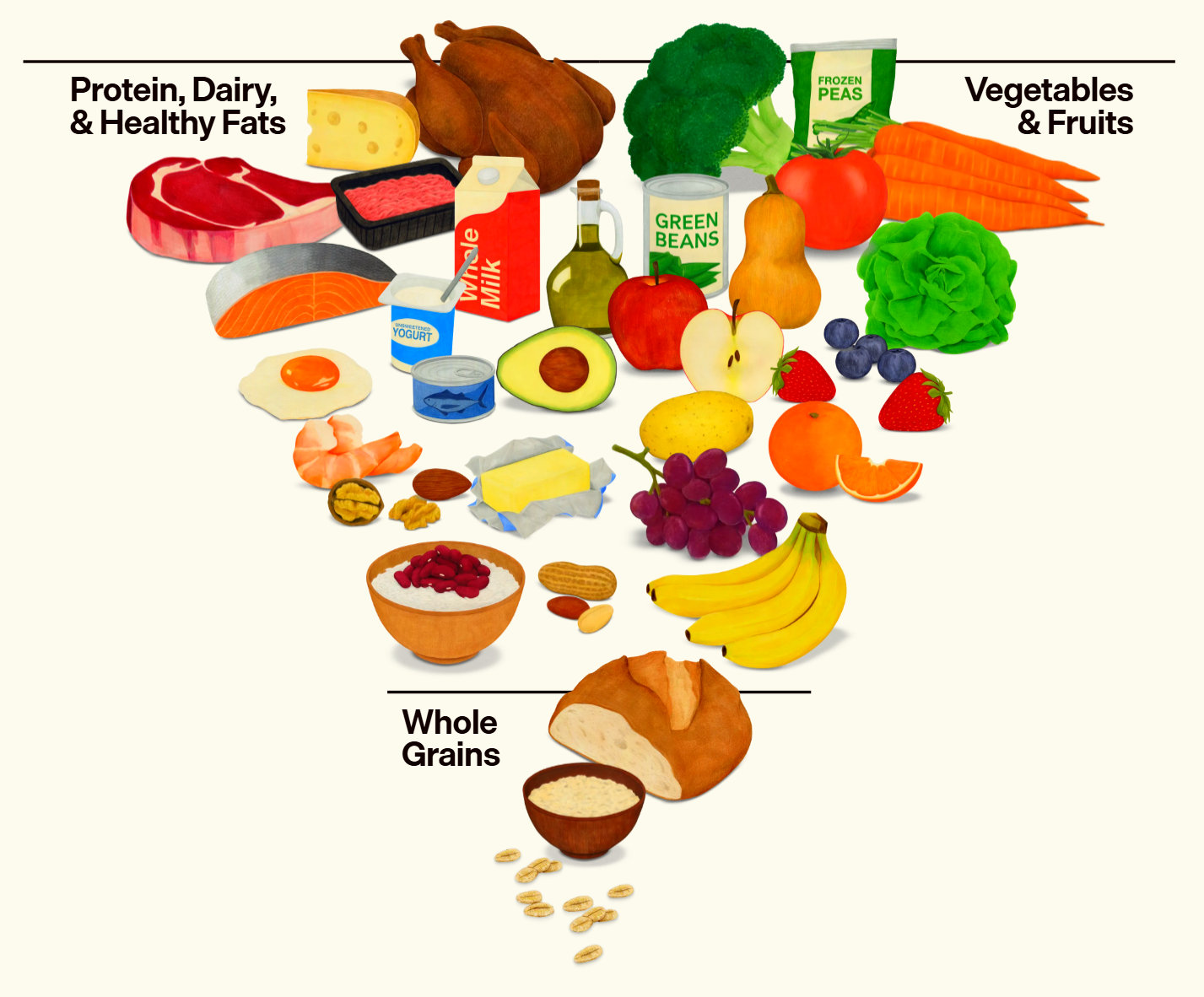
The document runs to just 9 pages, against 149 for the 2020 version. That is not only a matter of format: it signals a message deliberately simplified, owned, and meant to be understood without an intermediary.
Protein goes from 0.8g/kg/day to 1.2-1.6g/kg/day. For a 154lb (70kg) person that means 84 to 112g of protein a day against 56g before, roughly a doubling. Animal and plant sources are both recognized.
Whole-fat dairy is explicitly preferred to reduced-fat versions. The guidelines recommend 3 servings a day of dairy with no added sugar, drawing no distinction between whole and skim milk. The "low fat" recommendation that had stood since 1980 is gone.
Ultra-processed foods are named for the first time: "Avoid highly processed, packaged, sweetened or salted foods such as chips, cookies and candy." Previous editions limited specific nutrients (sodium, sugar, saturated fat). The 2026 edition targets the products themselves.
Grains drop to 2-4 servings a day, with heavy emphasis on whole grains. Refined grains (white bread, white rice, white flour) are explicitly discouraged. Grains are no longer the base of the diet.
Added sugar: no amount is recommended as part of a healthy diet. The per-meal limit is set at a maximum of 10g of added sugar.
For the first time, the 2025-2030 DGA set no limit on red meat consumption. Previous editions recommended limiting it. Red meat and butter are explicitly named as acceptable sources of protein and fat.
This is the most symbolically charged change of the edition. Since 1977, the year the McGovern report put fat reduction at the center of American public health policy, saturated fat was the enemy. Skim milk was "healthy", whole milk "risky". Butter had been replaced by margarine. "Low fat" products had taken over the shelves.
The 2025-2030 DGA officially declare that paradigm over. Saturated fat from dairy and meat is no longer presented as a risk factor to be eliminated but as an acceptable component of a diet built on whole foods.
It is the culmination of what independent research had been documenting for years: the PURE study (The Lancet, 2017), the 2022 and 2025 meta-analyses, and above all the re-examination of Ancel Keys's original work, gradually showed that the "fat causes heart disease" hypothesis rested on selected data and on research steered by the sugar industry.
💡 The full historical context of that re-examination is set out in the article The Ancel Keys affair: how the fear of fat was manufactured.
These new guidelines are not unanimously accepted in the scientific community, and it would be dishonest not to say so.
Researchers such as Walter Willett (Harvard) have condemned the revision process, arguing that "none of the usual scientific consultation process took place" under the Trump administration. The Center for Science in the Public Interest (CSPI) published a counter-document, the "Uncompromised DGA", setting out what the guidelines should have been according to the independent scientific advisory committee.
The criticism centers on two points: the absence of any limit on red meat (excessive consumption of which remains associated with certain cancers in the epidemiological literature), and the under-representation of plant protein sources in the recommendations.
This debate is not new. The history of dietary guidance is a run of reversals tied as much to political and industrial pressure as to scientific progress. What is certain: the new guidelines align better with the scientific literature on fat and ultra-processing than the previous versions did. But they are not free of political influence either, from the other direction this time.
These guidelines are American, not French. ANSES and the French health authorities have not yet updated the PNNS (the national nutrition and health program) along these lines. In practice, your family doctor probably still recommends semi-skimmed milk and limiting butter.
But the signal is strong. When the country that invented the low-fat dogma officially turns its pyramid over, that is not a marginal adjustment: it is an institutional acknowledgement that the direction taken since 1977 was wrong.
What these guidelines confirm in practice is what vraifood.com has argued from the start: food quality matters more than counting fat, unsweetened whole-fat dairy is a valid source of nutrition, protein is structurally under-eaten, and ultra-processing is the real food public health problem of our time.
💡 Going further: Hidden carbs: the perfect-score trap · The Ancel Keys affair
ℹ️ Sources
• Official publication: USDA & HHS, Dietary Guidelines for Americans 2025-2030, January 7, 2026. realfood.gov
• CNN analysis: New US dietary guidelines: CNN, Jan 7, 2026
• NBC News analysis: 6 biggest changes to know: NBC News, Jan 8, 2026
• Medical News Today : 4 key changes: Medical News Today, Jan 14, 2026
• Britannica : Dietary Guidelines for Americans: Encyclopædia Britannica
• Food Safety Magazine : Eat Real Food: Food Safety Magazine, Jan 7, 2026
• Fill Your Plate : A Historic Reset: Fill Your Plate, March 2026
• Criticism: STOP Obesity Alliance, George Washington University, Jan 2026